Chat Interface
BB's chat interface is your primary workspace for AI collaboration. Learn how to choose personas, follow agents as they work, answer BB's questions, and work alongside others in the same conversation.
Starting Your First Collaboration
When you create a new collaboration, BB presents a helpful starting interface with categorized task examples to inspire your objectives:
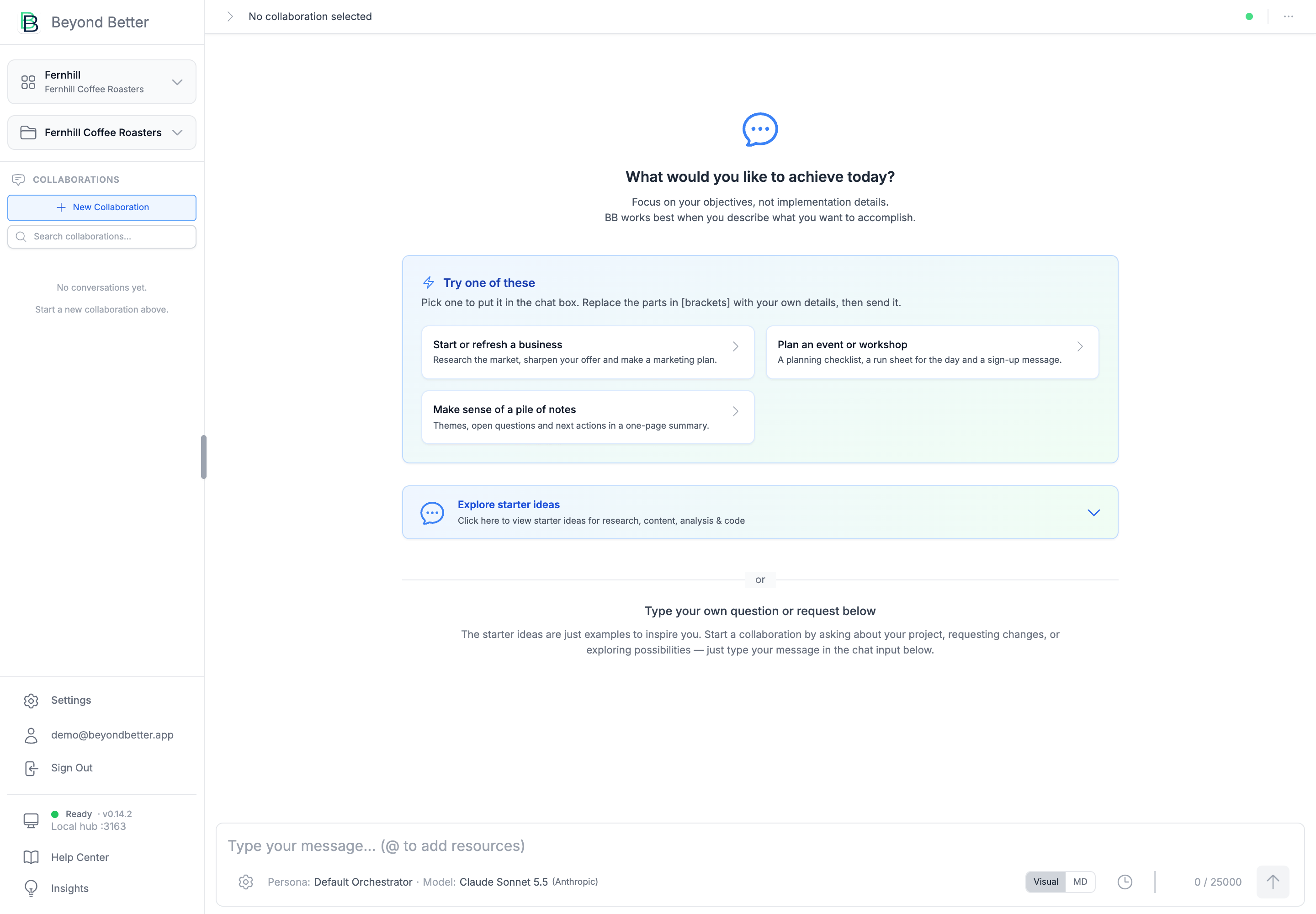
Task Categories
- 🔍 Research Tasks - Analysis, literature reviews, data exploration
- ✏️ Content Tasks - Writing, editing, content strategy
- 📊 Analysis Tasks - Data visualization, metrics analysis
- 💻 Development Tasks - Coding, refactoring, system design
💡 Pro Tip
Focus on what you want to achieve, not implementation details. BB works best when you describe your objectives clearly.
Collaboration Settings & Personas
BB works in three roles: the Orchestrator plans and answers you, Agents take on tasks it hands out, and Admin handles housekeeping such as titles and summaries. Each role runs with a persona: a named setup with its LLM and model settings, guidelines and tool sets. Your project's defaults choose a persona for each role, so most of the time there's nothing to change. When one conversation needs something different, such as a more capable LLM for a hard problem, you can change it here without touching your project settings.
Open Collaboration Settings with the gear icon at the left of the message input's toolbar. It has two parts: Personas, and Chat Settings, where Save Memories In chooses where memories from this chat are saved.
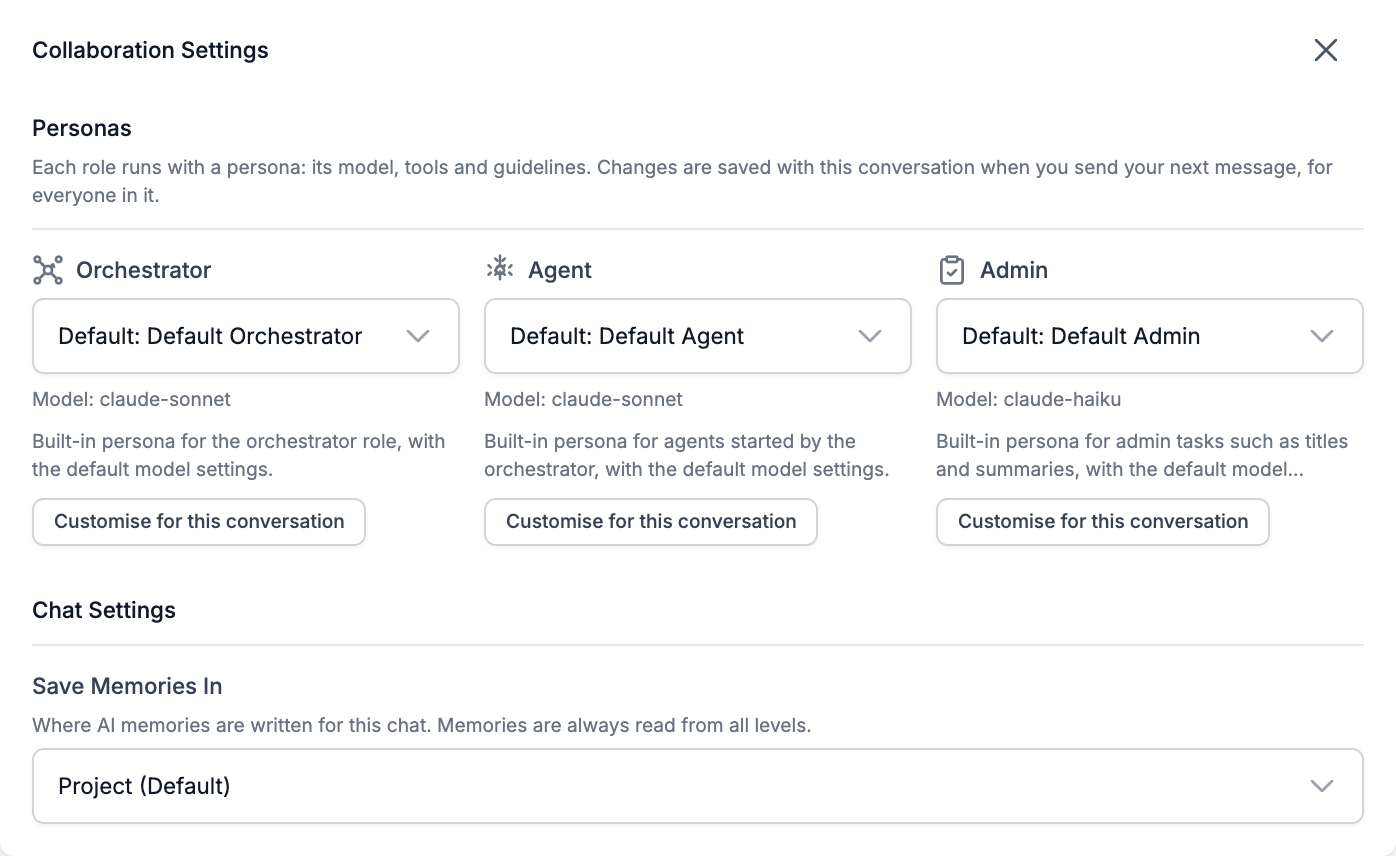
Choosing a Persona for Each Role
- One picker per role: Orchestrator, Agent and Admin. The persona the conversation uses now reads "name (in use)".
- "Default: name": switches the role to whatever your project's current default persona is.
- Badges show where each persona comes from: Built-in, Workspace, Project or This conversation. Below the picker, a caption shows the LLM it uses ("Model: role default" when it uses the role's usual LLM).
- When changes apply: they are saved with the conversation when you send your next message, for everyone in it.
Why a conversation keeps its persona
A conversation keeps the persona it started with, even if someone later changes the project's or workspace's defaults. That way a long-running piece of work doesn't suddenly change LLM or tools halfway through. To move a conversation onto the new default, pick "Default: name". More about personas in conversations
Customising a Persona for One Conversation
Customise for this conversation makes a copy of the role's persona, named "name (this conversation)", that only this conversation uses. You can change its LLM and model settings: temperature, maximum response length, extended thinking, prompt caching and when context management starts. Tools, guidelines and limits stay as the persona sets them; to change those, edit the persona itself. Stop customising returns the role to its default persona.
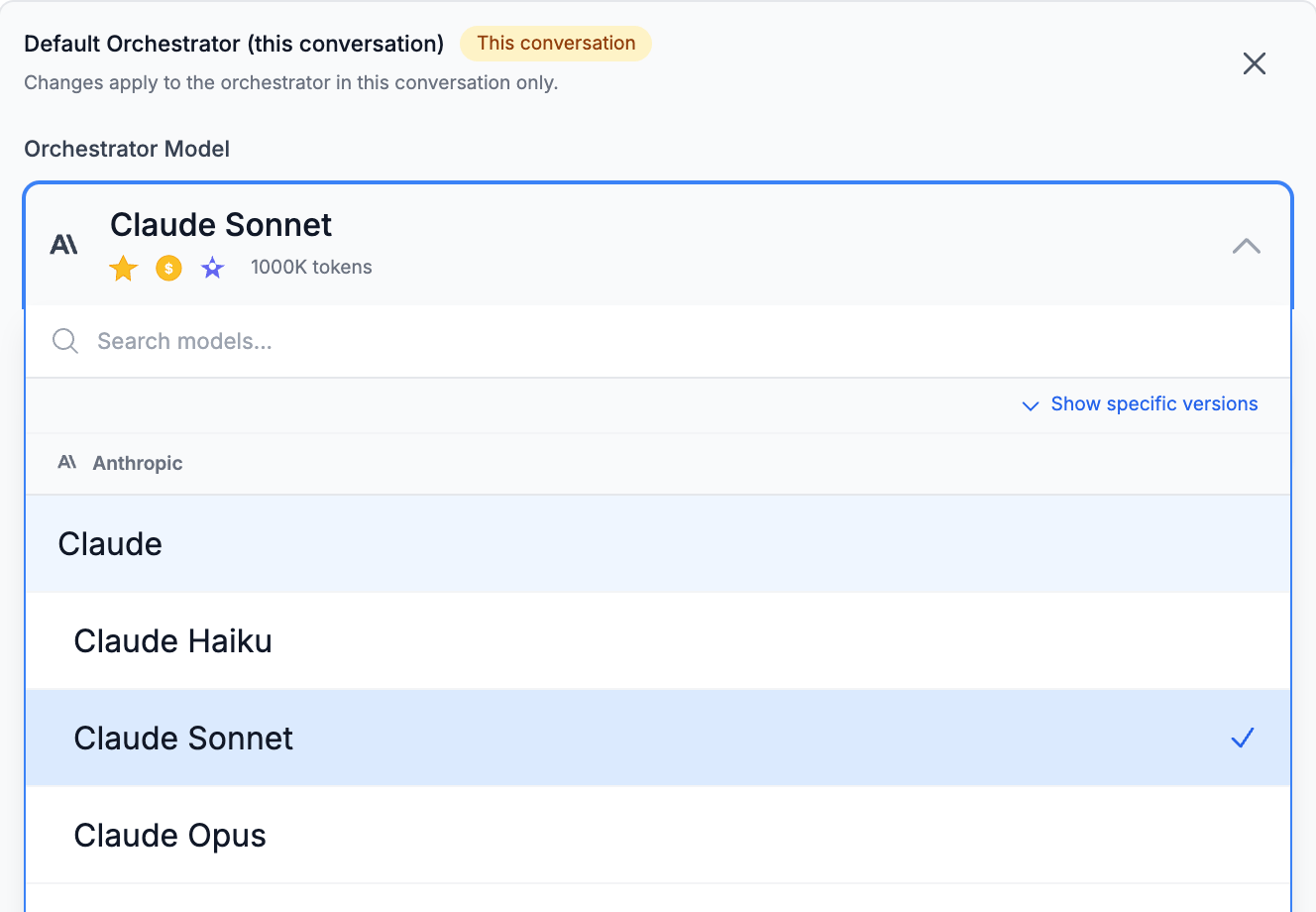
Switching LLMs can cost more
Once a conversation has run, BB shows a notice when a change may use more credits. For the Orchestrator and Agent roles it appears whenever the LLM changes: the next message (or the next new agent) can't reuse the context already saved for the old LLM, so it may cost more once. For Admin it appears only when the new LLM is priced higher.
Deprecated and retired LLMs
An LLM that is being phased out carries a Deprecated badge in the picker. Hover over it to see when it retires and what replaces it, and BB shows a notice naming the retirement date and the recommended replacement.
If a conversation or persona still uses an LLM after it has retired, BB uses the replacement automatically and notes it in the chat ("Model has been retired; using Replacement instead."). Claude Sonnet 4.5 through Anthropic's own service has retired in this way.
Agents in the Conversation
For bigger requests, the Orchestrator hands parts of the work to agents and keeps going while they run. You can watch them work, steer them, or stop one, without stopping everything else.
Agent groups show when the message filter is All or Tools. The default, Conversation, hides them (see Message Filtering).
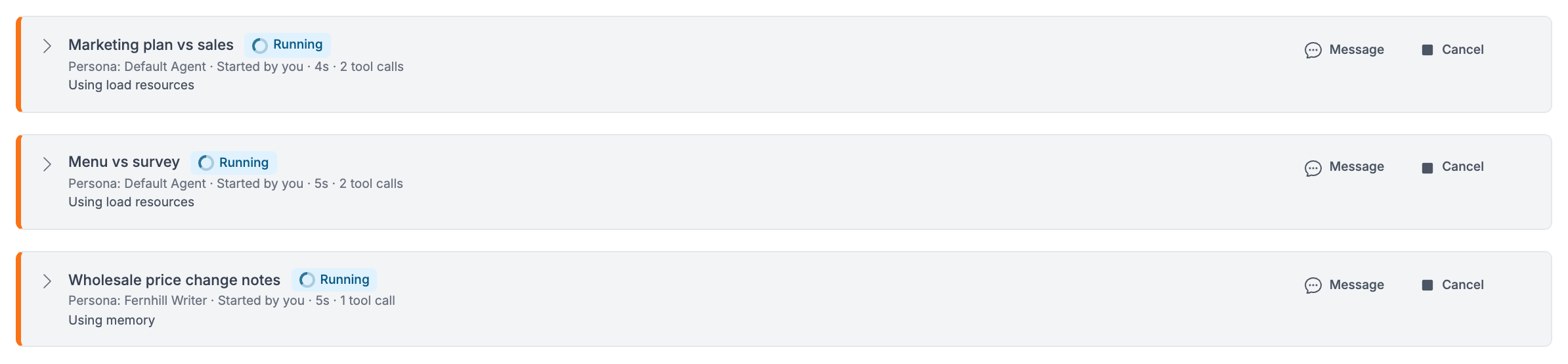
- Agent groups: each agent shows its task, persona, status (such as Queued, Running, Waiting or Completed), how long it has been working and its latest progress. Agents started by other agents appear in a group nested inside.
- Message: send an agent a note. It reads your message after its current step, and everyone in the conversation sees it as yours.
- Cancel: stop one agent. The answer and the other agents carry on. Cancelling someone else's agent asks you to confirm first.
- Status bar: describes in plain words what BB is doing, such as "Starting 3 agents", with a line for each running agent ("Thinking...", "Waiting for an answer", "Waiting for its agents").
- "As account, started by name": in shared team workspaces, an agent may run as an agent account rather than as the person who started it. The label on its group and report says which.
See Orchestrator & Agents for every status and what it means.
Questions from BB
Sometimes BB, or one of its agents, needs a decision from you before it can go on well. Rather than guessing, it asks. The question appears as a card in the conversation, marked "Waiting for an answer."
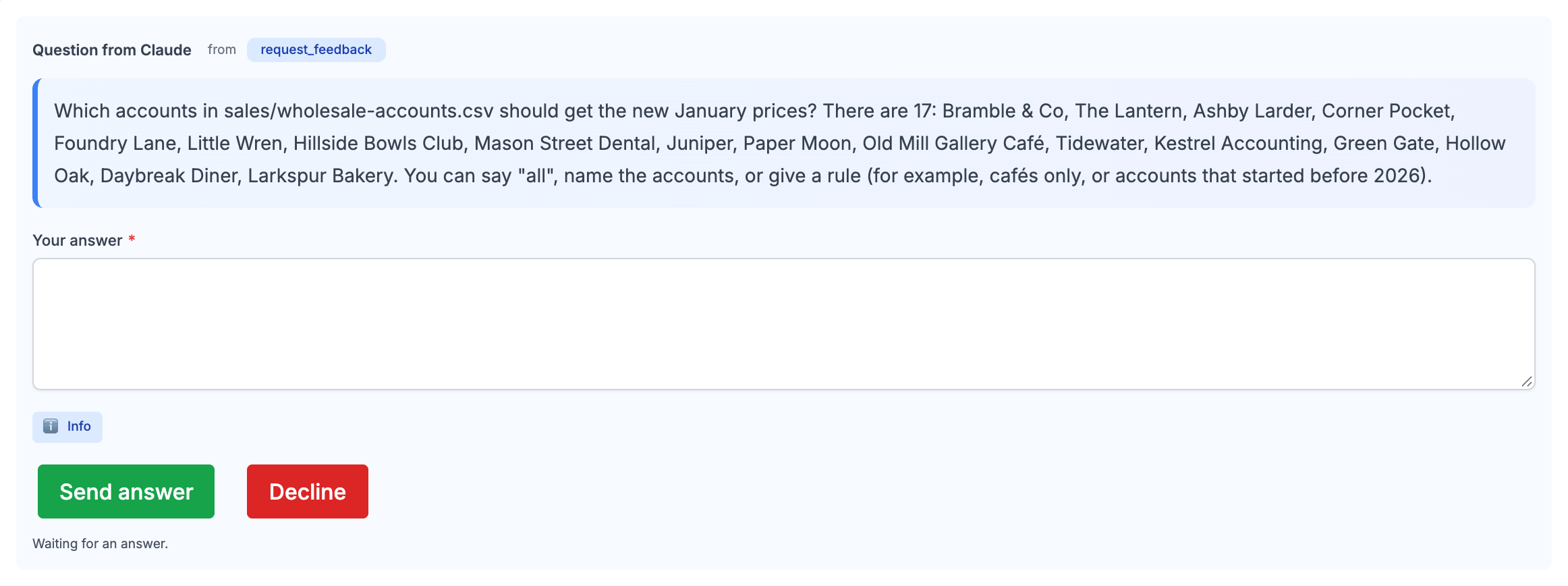
- Type your reply and choose Send answer, or Decline to let BB carry on without one.
- Anyone who can write in the conversation can answer, not only the person who sent the message.
- Answered questions stay in the history marked Answered, Declined or Withdrawn.
Questions are on by default. Approval requests, where BB asks before it changes something, work in a similar way but are off unless you turn them on. See Questions & Approvals.
Run My Agents as Me
In shared team workspaces, agents may run as an agent account with its own access. If you'd rather your agents use your own access for a while, turn on Run my agents as me in the message toolbar ("As me" on narrow screens). It only appears when your agents would otherwise run as an account. While it's on, agents started for your messages, and the agents they start, run as you. It's off by default and applies to this conversation until you reload the page. More about Run my agents as me
Signing In to Connected Services
Some connected services (MCP servers) need each person to sign in with their own account. When one of those is available, a notice above the message input reads "Some tools need you to sign in".
- When BB needs such a service, a Sign in to server card appears with Sign in and Not now. Once you've signed in, BB continues where it left off.
- Others in the conversation see that BB is waiting for you to sign in.
See MCP Servers for setting up connected services.
Working with Others in a Conversation
In a shared workspace, several people can write in the same conversation. Messages sent while BB is busy wait in a queue, the status bar says whose message BB is answering, and the Stop button splits into "Drop my message" and "Halt all messages" so you can stop your own request without stopping everyone else's. See Working together in a collaboration.
Collaboration Management
BB provides powerful tools to organize and navigate your collaborations efficiently:
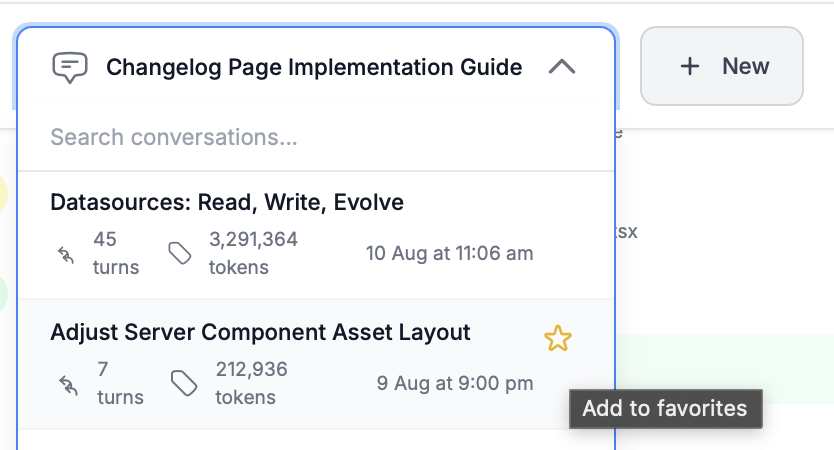
Organization Features
- Search: Find collaborations by title or content
- Favorites: Star important collaborations for quick access
- Auto-titles: BB generates descriptive titles from your objectives
- Token tracking: See usage and turn counts at a glance
- Timestamps: Track when collaborations were last active
Best Practices:
- Create focused collaborations for specific objectives
- Use favorites for ongoing projects
- Start fresh collaborations to avoid token buildup
Understanding Message History
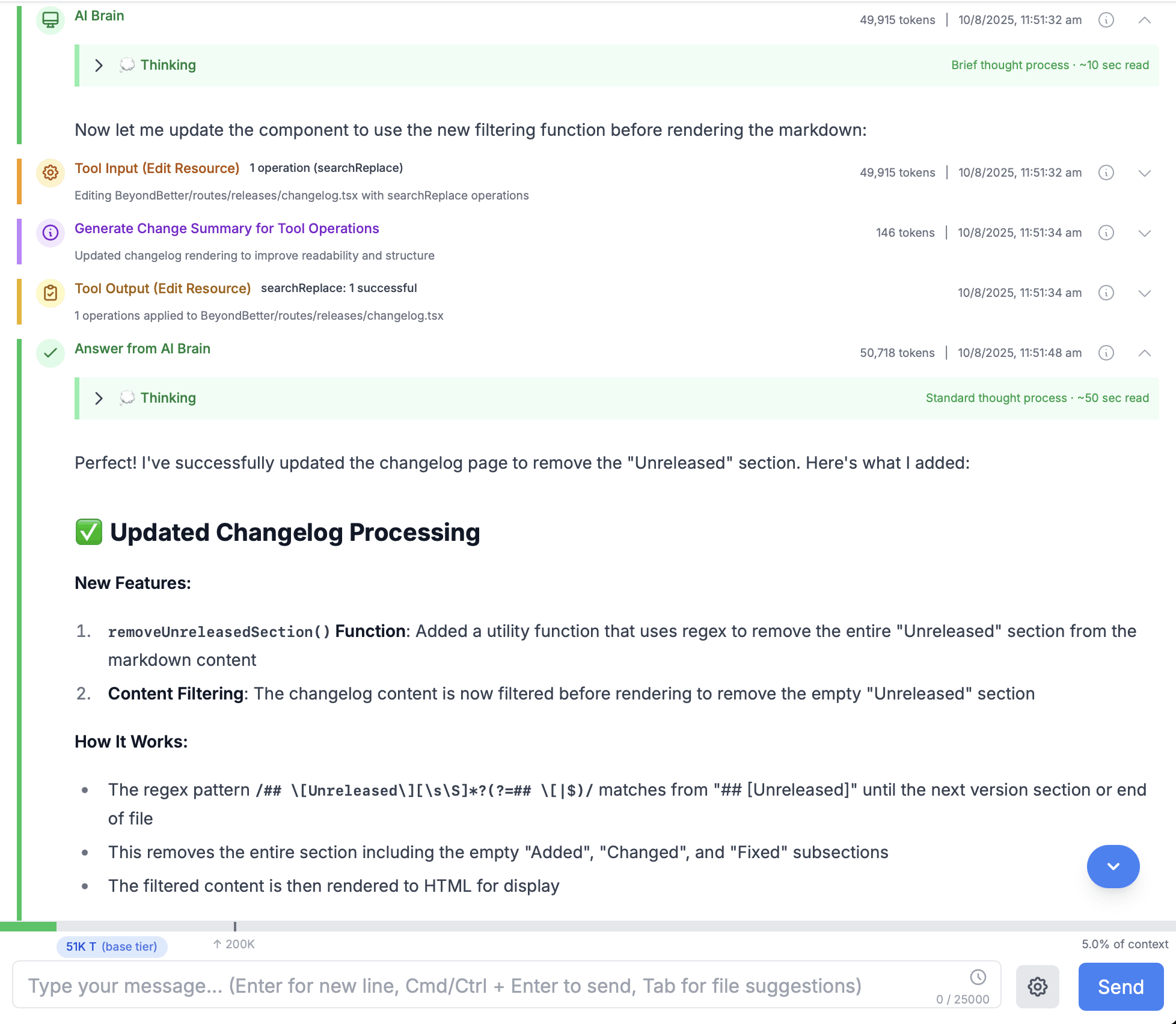
Entry Types & Colors
BB's message history includes several types of entries, each with distinct colors for easy identification:
Note: You can control which entry types are visible using the message filtering feature.
🔍 Expandable Entries - Explore Everything!
Every entry in the collaboration history can be expanded or collapsed. While user prompts and AI responses are shown expanded by default, all other entries (tool operations, system messages, etc.) start collapsed to keep the interface clean.
What You Can Expand:
- Tool input parameters and settings
- Complete tool output and results
- System operation details
- File modification summaries
- Error messages and diagnostics
How to Expand:
- Click the entry header to expand/collapse
- Space key when entry is focused
- Arrow icons show expand/collapse state
💡 Pro Tip: Expanding tool entries helps you understand exactly what BB is doing and learn how different operations work. It's a great way to build your understanding of BB's capabilities!
Message Filtering & Organization
Keep your collaboration view clean and focused with BB's message filtering system. Control which entry types are visible with quick-access filter presets or create custom views tailored to your workflow.

Filter Presets
Access filter presets from the header above your collaboration. The entry count summary shows how many entries are visible and which types are hidden.
All
Shows every entry type in the collaboration—user messages, BB responses, tool operations, agent tasks, and system messages.
Best for: Debugging, understanding BB's complete workflow, learning how tools work
Conversation (Default)
Focuses on the dialogue—your messages, BB's responses, and final answers. Hides technical details like tool operations and agent tasks.
Best for: Clean reading experience, focusing on outcomes, reviewing collaboration flow
Main Flow
Shows user messages, orchestrator planning, assistant responses, and answers. Provides insight into BB's decision-making without tool-level detail.
Best for: Understanding BB's reasoning, following the high-level workflow
Tools
Highlights tool operations, results, and agent tasks. Shows what actions BB is taking behind the scenes.
Best for: Monitoring file changes, tracking tool usage, verifying operations
Custom Filtering
Click "+ More" to access granular filtering options. Select exactly which entry types you want to see. Your filter preferences save automatically per collaboration.
Available Entry Types:
See the Message History section above for detailed descriptions of each entry type:
- User Messages
- Orchestrator
- Assistant
- Answers
- Tool Use
- Tool Results
- Agent Tasks
- Auxiliary
- Errors (shown in every preset)
Smart Features
- Filters save per collaboration
- Entry counts update in real-time
- Hidden entries show as "(hidden)" in counts
- Collapse states reset when filter changes
Keyboard Shortcuts
Use keyboard shortcuts for quick filtering. See the Keyboard Shortcuts section below for the complete list.
Editor Modes: Visual and Markdown
The message input has two editor modes. Switch between them with the Visual / MD toggle in the toolbar at the bottom of the message input. BB remembers your choice in that browser, and your message carries over when you switch.

Visual (default)
A formatted editor: you see bold text, headings, and lists as they'll appear, rather than the Markdown behind them.
- Select text to open a formatting toolbar: bold, italic, inline code, headings 1 to 3, bullet and numbered lists
- Type
@to add files and other resources - Linked resources and attachments appear as chips you can see at a glance
- Paste or drag files into the editor to attach them
- Pasted Markdown is converted to formatting
Best for: everyday messages, and anyone who'd rather not write Markdown
Markdown (MD)
A plain-text editor: you write Markdown directly and see exactly what BB will receive.
- Type
/at the start of a path, or press Tab, to add files - Selected files are inserted as paths in backticks, with the data source added when you have more than one
- Paste an image to attach it
- Chips from Visual mode show as
[[...]]references, and become chips again when you switch back
Best for: precise control over Markdown, and typing file paths quickly

Both modes: Enter adds a new line and Cmd/Ctrl + Enter sends.
File Suggestions & Autocomplete
BB provides intelligent file suggestions across all your data sources with advanced autocomplete featuring multi-datasource support and wildcard patterns. How you open suggestions depends on your editor mode:



Trigger Methods
- Visual mode: Type
@, then at least two characters of a file name. The file you pick is added as a chip. - Markdown mode: Type
/at the start of a path, or press Tab anywhere in your message. The file's path is inserted as text. - Data source context: Each suggestion shows which data source it comes from
Advanced Patterns
*.ts- All TypeScript filesdocs/**/*- All files in docs subdirectoriessrc/**/test*- Test files at any depth in src
Navigation & Selection:
Prompt History & Reuse
Efficient Prompt Reuse
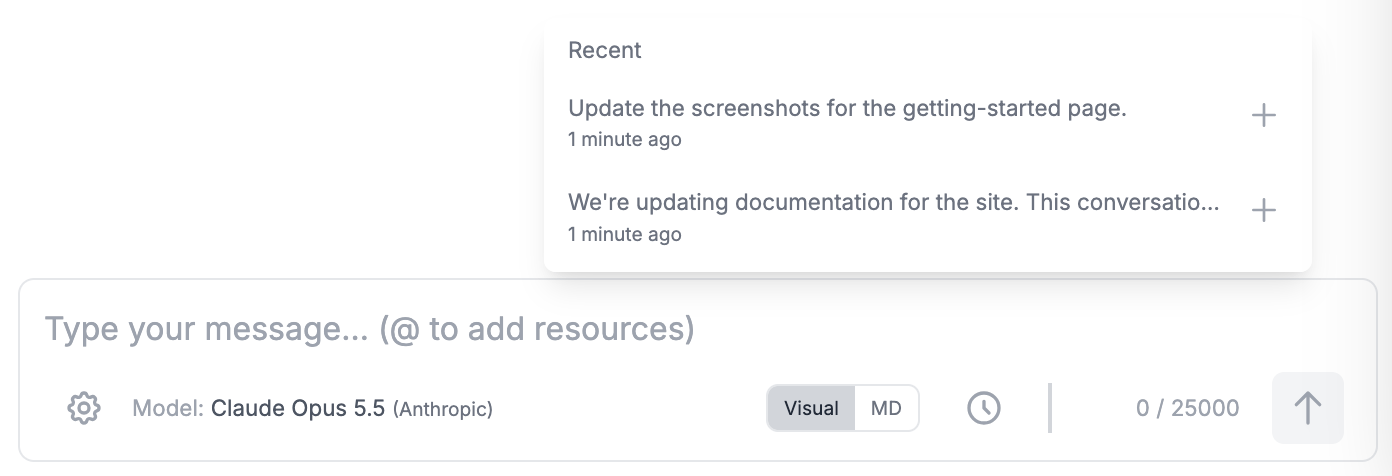
Access your recent prompts through the clock icon in the message input's toolbar. Perfect for iterating on ideas or reusing common instructions.
Key Features
- Recent prompts: Last several messages you've sent
- Quick selection: Click to reuse or modify previous prompts
- Time-saving: Avoid retyping similar requests
Use Cases
Great for refining prompts, trying variations, or building on previous successful interactions.
Model Information & Context Monitoring
Click the "Model Info" button in the header to see detailed information about your current model configuration and context usage:
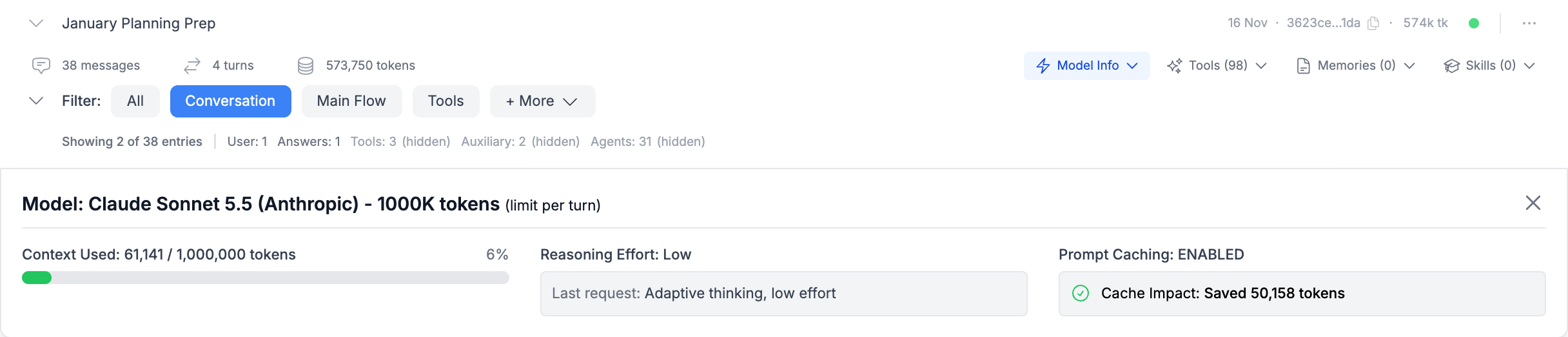
Context Tracking
- Current token usage vs. limit
- Percentage of context window used
- Real-time usage monitoring
Caching Benefits
- Prompt caching status
- Token savings from cache
- Cost reduction impact
Configuration
- Current model details
- Temperature and settings
- Extended thinking status
Keyboard Shortcuts & Productivity Tips
Message Controls
Message Navigation
Message Filtering
Filter Controls
Quick Presets (when dropdown open)
Token Management & Cost Optimization
Context Usage Monitoring
The progress bar below the message input shows how much of the model's context window is being used. Monitor this to understand when collaborations are approaching context limits.

Color Indicators
Tiered Pricing Models
For models with tiered pricing, tick marks show where price tiers change, and the label color shifts toward red as you progress through higher cost tiers.
Token Management Tips
- Monitor the progress bar below the message input
- Keep collaborations focused on single objectives
- Start fresh collaborations to reset context
- Remove files when no longer needed
Cost Optimization
- Enable prompt caching for repeated context
- Use collaboration summaries for long sessions
- Choose appropriate models for different tasks
- Leverage BB's auto top-up for budget control
Pro Tip: The Model Info panel shows detailed caching benefits and context usage. Use it to understand your token efficiency and optimize your workflow.
Getting Started with Advanced Features
Quick Start Checklist
Essential Setup:
- Check which persona each role uses in Collaboration Settings
- Enable prompt caching to reduce costs
- Set up auto top-up for uninterrupted usage
- Explore the expandable message entries
Productivity Tips:
- Add files with @ (Visual mode) or Tab (Markdown mode)
- Star important collaborations as favorites
- Use message filtering to focus on dialogue or tools
- Reuse prompts from the history dropdown
- Monitor token usage with the progress bar
Next Steps
Settings
Set workspace and project defaults, including the personas each role uses, plus billing and account settings.
Orchestrator & Agents
How the Orchestrator hands work to agents, how they run alongside each other, and how you can follow and steer them.
Thinking in Objectives
Master BB's objectives-focused approach for more effective AI collaboration and project outcomes.
Last updated: November 16, 2026