Settings
Settings is where you decide how Beyond Better works for you and your team: who belongs to your organization and how it's billed, what every project in a workspace starts with, and your own preferences. Open it with the Settings link at the bottom of the side navigation.
Settings sections at a glance
The section menu lists these sections, in this order. Each section has its own tabs, and your browser's Back and Forward buttons move between the tabs you've opened. Old links to settings pages still work.
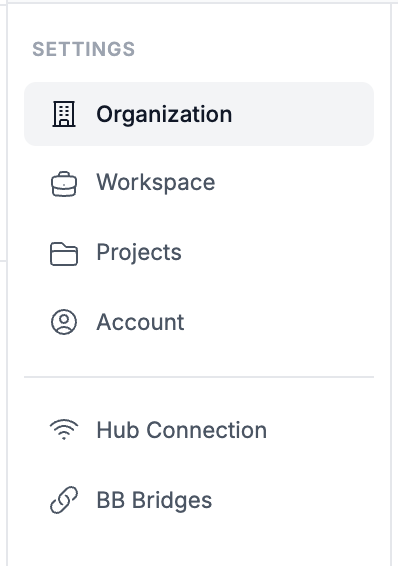
Organization
General, People, Workspaces, Connections, Billing, Usage, Alerts
Workspace
General, Project Defaults (General, Personas, Tools, Skills), API Tokens, Agent Accounts, Connections
Projects
Create and manage your projects — the Project Manager
Account
General, Appearance, Notifications, Privacy
Export & Import
Only appears when your organization has it switched on.
Hub Connection
Choose between Cloud Hub, Local Hub, and Custom Hub
BB Bridges
Pair BB Bridges with this workspace and manage the ones already paired. Desktop only; not shown on phones.
Who can see and change what
Settings that affect other people are protected, so one member can't change how the whole team works by accident.
- Billing and Usage: only organization owners and admins see these tabs.
- Alerts: everyone can see them; only organization owners and admins can change them.
- Workspace settings (including Project Defaults, personas, Workspace Guidelines, workspace skills and MCP servers): team leads and owners of the workspace's team, and organization owners and admins, can change them. Other members see them read-only.
- Account: your own preferences; only you can change them.
How Settings Are Inherited
Most BB settings are set in layers. Each layer inherits from the one above it, so you configure your defaults once and only change what's different further down.
1. Workspace
Defaults for every project in the workspace, set in Settings > Workspace > Project Defaults.
2. Project
Overrides for one project, set when editing the project.
3. Collaboration
Overrides for a single conversation, such as which persona each role uses and the default memory scope.
Badges and the Reset Button
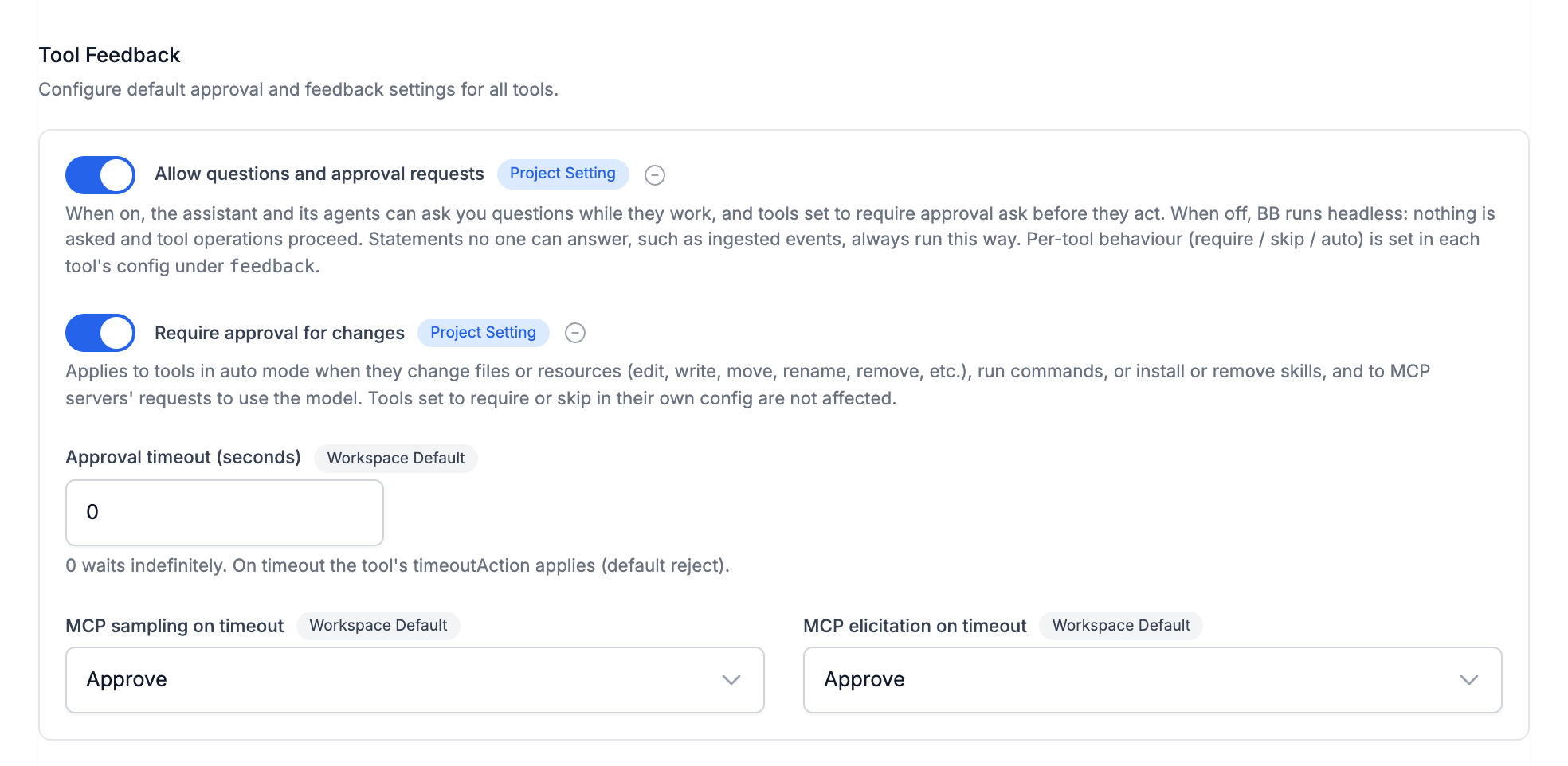
When you edit a project, each setting shows where its value comes from:
- Workspace Default: the project uses the workspace value. If the workspace setting changes, this project follows it.
- Project (or Project Setting): the project has its own value. It's always followed by a ⊖ reset button.
- ⊖ Reset: removes the project's value so the setting goes back to the Workspace Default.
How Overrides Combine
- Each setting is inherited separately. Changing one setting in a project doesn't affect the others.
- Tool configurations combine. A project's configuration for a tool only overrides the values it sets. Anything it doesn't set, and every other tool's configuration, is still inherited from the workspace.
- Lists are replaced. For list settings, such as selected tool sets, the project's list replaces the workspace list entirely.
Personas Follow the Same Layers
Personas (which model, guidelines and tool sets each role uses) are layered the same way, with BB's built-in personas below the workspace: Built-in, then Workspace, then Project, then the conversation.
Personas don't combine field by field. A persona with the same ID at a lower level replaces the one above it completely. How persona levels work →
Coming soon. Organization-level defaults that apply to every workspace in your organization.
Organization
The Organization section covers your organization as a whole: its people and teams, its workspaces, its connections to AI providers, and its billing.
General
Your organization's name, description and ID.
Run agents as service accounts
In a shared organization, this policy decides whether agents may run as agent service accounts: Allowed or Not allowed. Workspaces and projects can only make it stricter. Learn about the policy →
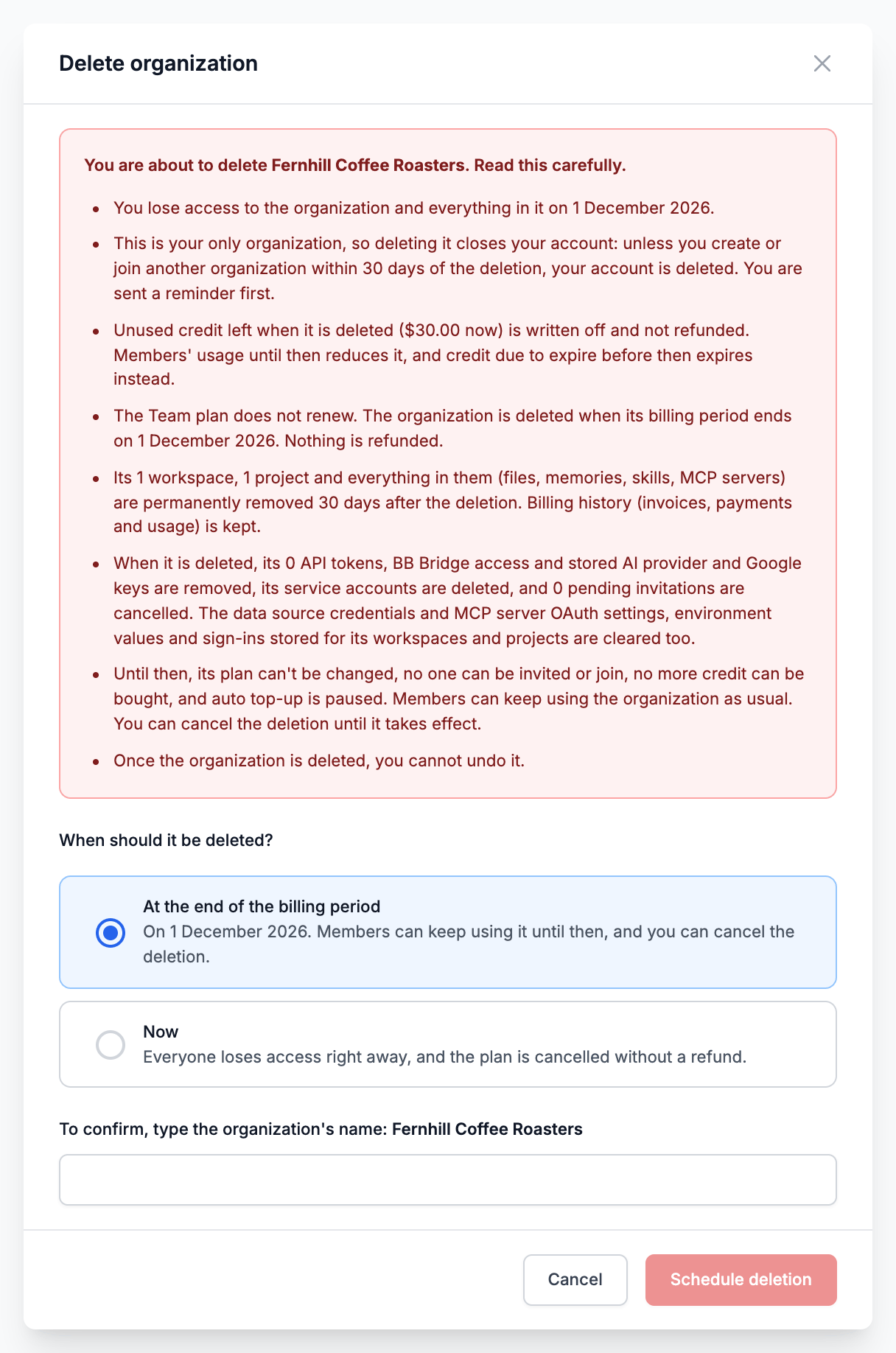
Danger Zone: deleting an organization
Only the owner of an organization can delete it, with Delete organization…. BB asks When should it be deleted?, and you type the organization's name to confirm:
- At the end of the billing period: members keep using the organization until then, and you can still change your mind (not available on the Free plan). While deletion is scheduled, a banner shows it, the plan can't be changed, nobody can be invited, credits can't be bought and auto top-up is paused. Cancel deletion stops it, and members are emailed.
- Now: everyone loses access right away, and the plan is cancelled without a refund.
The organization's data is permanently removed 30 days after it's deleted. Billing history is kept. Remaining credit is not refunded.
People left without an organization see "You don't belong to any organization", any invitations waiting for them, and a button to Create your personal organization. BB doesn't create one for them. Their account is deleted 30 days later unless they create or join an organization; they get a reminder about 7 days before.
People
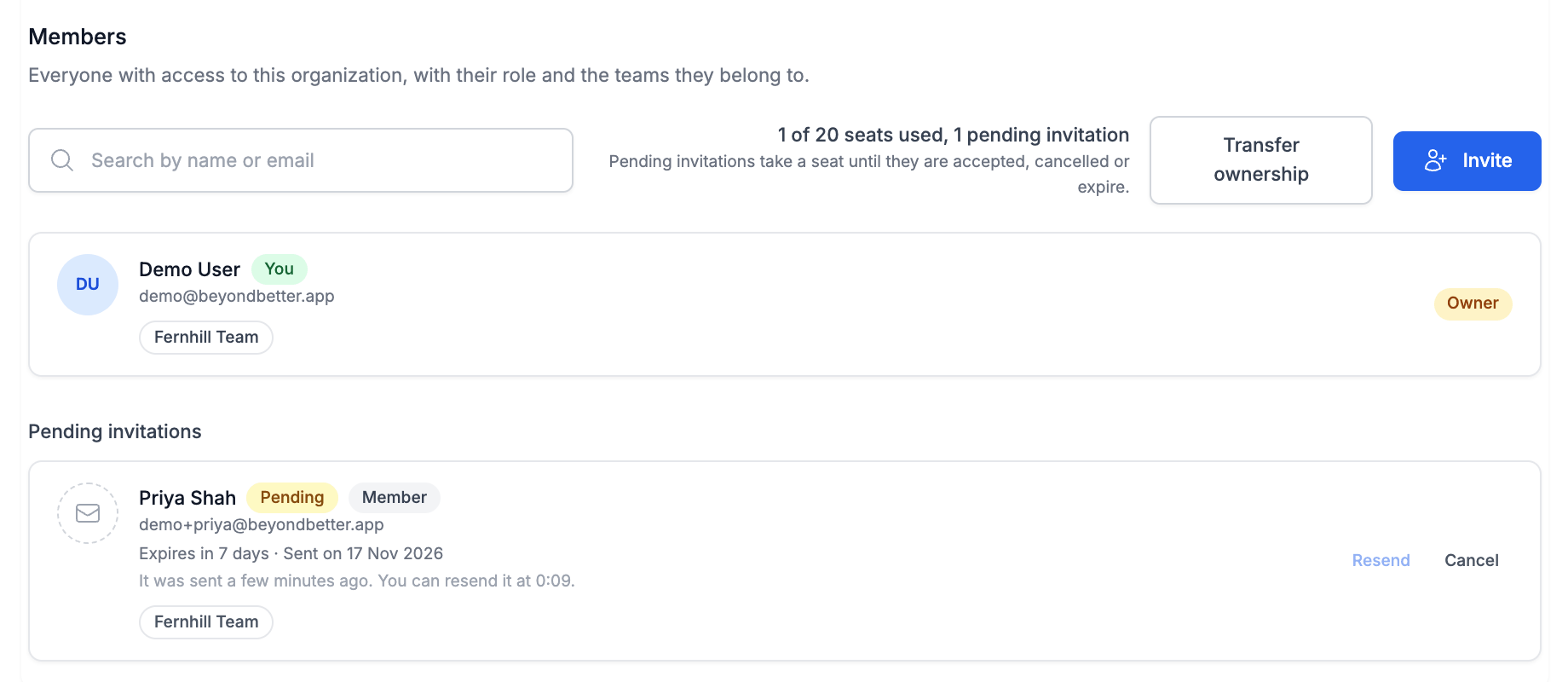
Who belongs to your organization and how they're grouped into teams, in two sub-tabs:
- Members: everyone in the organization. Organization owners and admins can invite people with Invite. Pending invitations are listed too, with Resend and Cancel, and count towards your seats until they're accepted or cancelled. Resending is limited: if it's too soon, BB says when you can send it again.
- Teams: each team and its members. Organization owners and admins create teams, add members, and make a member a team lead.
Workspaces
Where each team works: the workspaces in your organization, grouped by team.
Connections
- AI providers: connect your organization's own accounts with LLM providers, such as AWS Bedrock. A saved key is shown as "•••• configured", with Remove key. Reset to defaults asks first, then removes the organization's settings and saved key for that provider.
- Google service accounts: add one with Upload key file.
Keys are stored encrypted and only ever shown masked; nobody can read them back. To change a key, enter a new one.
Billing
Manage your subscription, credits and payment details (owners and admins only):
- Account Overview: Current plan, credit balance, and usage summary
- Credit Management: Purchase additional credits as needed
- Payment Methods: Manage cards and billing information
- Plan Switching: Upgrade or change subscription plans
- Billing details: The billing contact and address
- Auto Top-up: Automatically purchase credits when your balance gets low
Auto Top-up
Set up automatic credit purchases so your workflow is never interrupted:
- Minimum Balance: The threshold that triggers a purchase. It's $5.00 if you don't set it, and must be at least $1.00.
- Purchase Amount: How many credits to buy when triggered
- Daily Limit: Maximum spend per day — protects against unexpected charges
If a top-up is declined, BB waits a while before trying again. If it can't run because there's no payment method, owners get an email.
Recommended: Set minimum balance to 2–3× your typical daily usage. Set daily limit conservatively.
Usage
Monitor your BB usage patterns and spending (owners and admins only):
- Usage Analytics: Track spending, requests, and token usage
- Time-based Filtering: View usage by day, week, or month
- Model Breakdown: See which models you use most and their costs
- Trends: Understand your usage patterns over time
- Usage by Account: what agent service accounts used, switchable between By account and By who started it. More about agent accounts
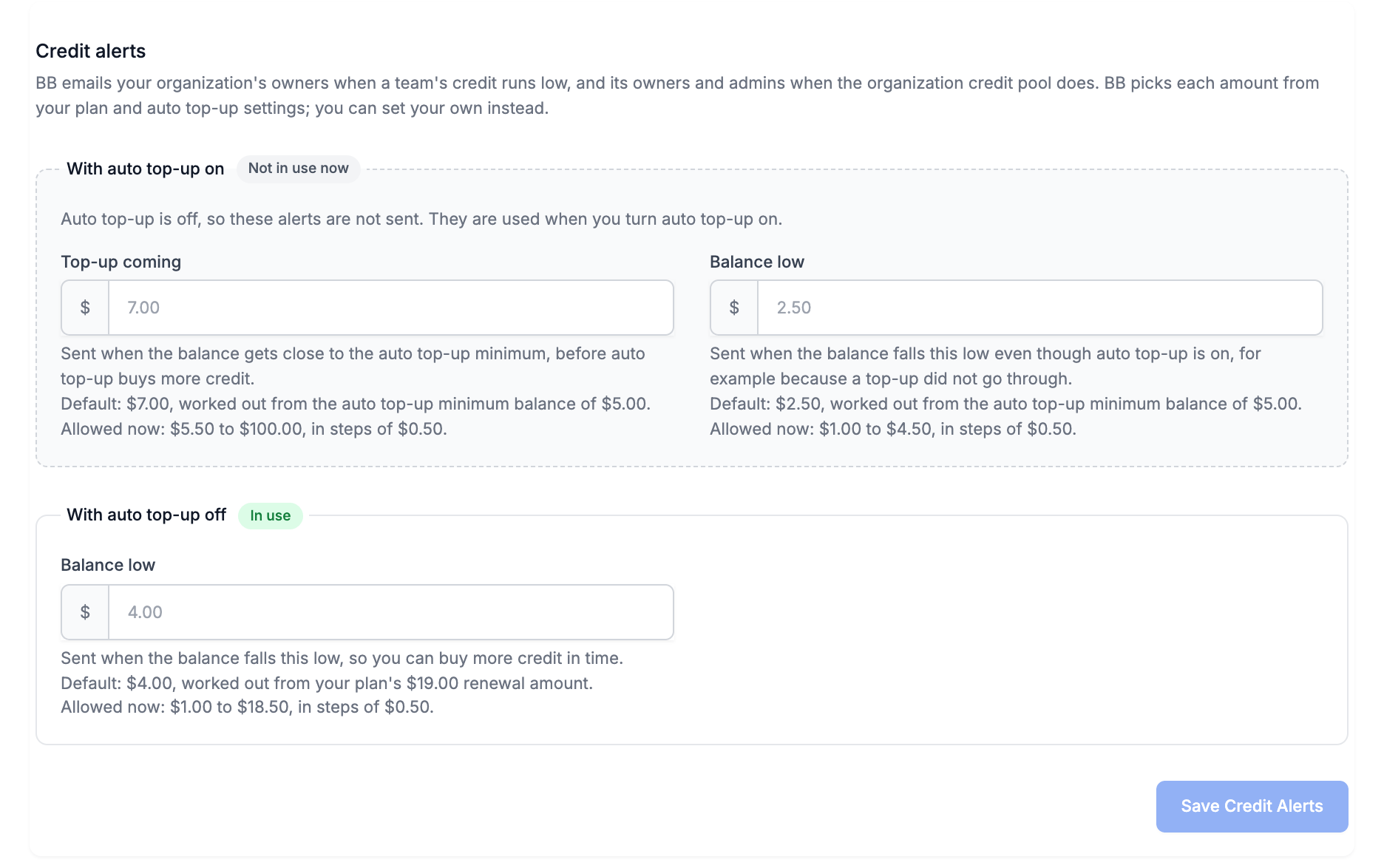
Alerts
Get an email before you run out of credit. In Credit alerts, organization owners and admins choose the balance that counts as low; everyone else can see the settings.
- With auto top-up on: "Top-up coming" and "Balance low" amounts.
- With auto top-up off: a "Balance low" amount.
Each amount shows its default and how it's worked out. Choose Use the default to go back to it, and Save Credit Alerts to keep your changes.
Alerts about a team's credit go to owners; alerts about the organization's credit pool go to owners and admins.
Workspace
The Workspace section sets defaults that apply to all projects in your workspace — unless a project overrides them. Team leads and owners of the workspace's team (and organization owners and admins) can change these settings; other members see them read-only.
General
The workspace's name, description and ID.
Project Defaults
What every project in the workspace starts with, in four sub-tabs:
General
- Human Name: The label for the human side of conversations, shared by the team
- Assistant Name: What BB calls itself
- Save Memories In: Where new memories are saved by default (see below)
- Maximum Turns: Limits tool usage to prevent runaway loops
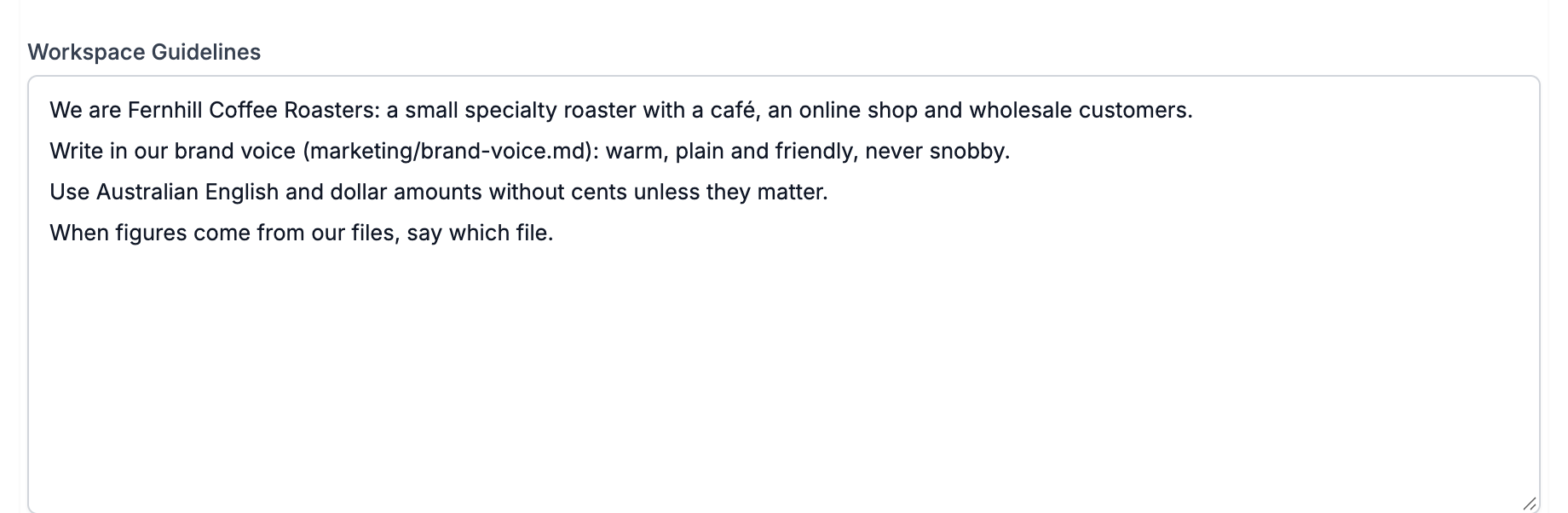
- Workspace Guidelines: Instructions BB follows in every project of this workspace. They come first, followed by each project's own guidelines and the persona's. Learn about guidelines
Save Memories In
Memories are always read from all levels; this setting controls where new ones are written by default.
- Workspace (All Projects): Visible to all team members — good for team conventions and shared context
- Project (Default): Available to all collaborations within a project — good for project-specific decisions
- Collaboration (Each Conversation): Specific to one conversation only
Recommended: Keep the default set to Project for most workflows. Learn about the memory system
Personas
BB works in three roles: the Orchestrator (the main assistant you talk to), Agents (which take on tasks the orchestrator hands out) and Admin (titles, summaries and other housekeeping). Each role runs with a persona: a model and its settings, guidelines and tool sets. Here you choose each role's default persona for the workspace and create your own.
A persona's model settings include reasoning and Context Management, which controls when BB starts clearing older context in long conversations.
Tools
Control which tools are available to BB across all projects by default. Individual projects can override these workspace defaults.
- Select tool sets (core, editing, coding, research, etc.)
- Create custom tool combinations from built-in sets and MCP servers
- Configure individual tool behaviours with YAML
- Decide when BB asks you questions or needs your approval
API Tokens
Tokens that let other systems access this workspace. Organization owners and admins can see and manage the API tokens of every shared workspace.
Agent Accounts
Accounts that agents in this workspace can run as, instead of as the person who starts them. Agent accounts are not API tokens. They are only available in shared team workspaces: in a personal workspace this tab explains that, and suggests switching to a shared team's workspace.
Learn about agent accounts →Connections
The workspace's MCP servers, which connect BB to external tools and services. Only team leads and owners (and organization owners and admins) add, change or remove them. Other members see the list read-only, and can still sign in to a server for themselves when it needs each person's own sign-in.
Learn about MCP Servers →Projects
The Projects section is the Project Manager — create, import, edit, and delete your projects from here. Editing a project lets you override the workspace's defaults for that project.
Learn about the Project Manager →Account
Personal preferences that apply to your account, independent of workspace settings.
General
Your name and email. Changes save when you leave a field or press Enter.
Appearance
- Theme: Light, Dark, or System (follows your device setting)
- Theme preference is saved to your account
Notifications
- Audio Notifications: Play sounds when BB finishes processing
- Browser Notifications: System notifications, even when BB is in the background
- Visual Indicators: Update browser tab title and favicon
- Custom Audio: Use your own notification sounds
Privacy
Control privacy and data handling preferences for your account.
Hub Connection
Choose which hub BB connects to — Cloud Hub, Local Hub, or a Custom Hub on your company's network. Your choice determines where your data lives and which workspaces you see.
Learn about Hub Connection →Next Steps
Project Manager
Create and manage your projects — now accessible from Settings > Projects.
Personas
Choose the model, guidelines and tools for the Orchestrator, Agent and Admin roles.
Teams & Workspaces
How teams share workspaces, and who can change workspace settings.
Hub Connection
Cloud Hub, Local Hub, or Custom Hub — choose where your data lives.
Last updated: November 18, 2026